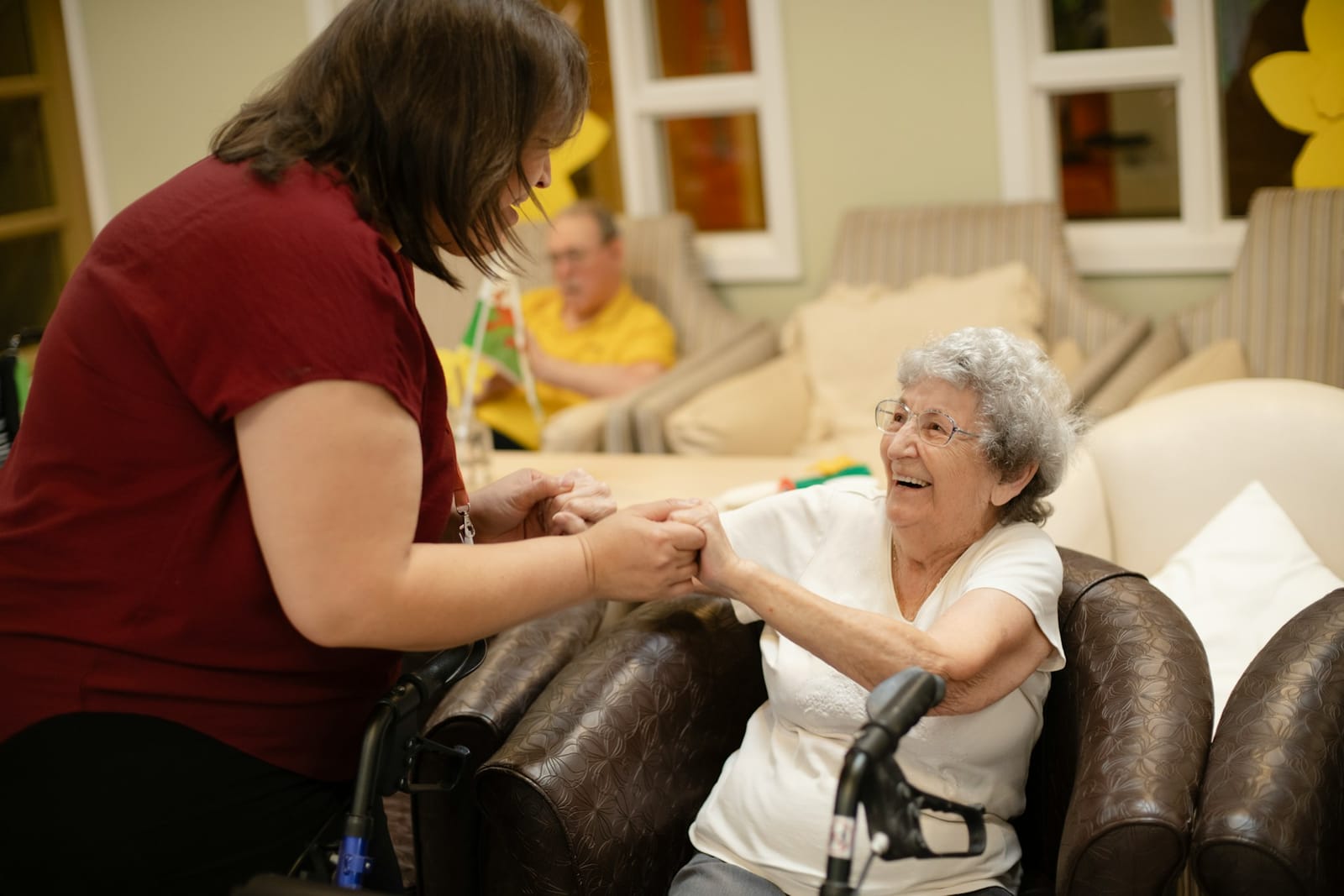


Nobody asks this question out loud on the first tour.
They ask it in the car three weeks later, alone, doing math about Tuesdays. Is twice a week enough. Is once a week terrible. Would a better daughter go every day.
Here's the thing about that math: it's usually being done by someone who is exhausted, and exhausted people set targets they cannot keep.
Quick answer: How often should family visit? There is no clinical standard, and research has not identified an optimal visit frequency. Most families settle into one to three in-person visits a week, supplemented by phone or video contact. What the evidence supports is that consistency and visit quality matter more than raw frequency, and that visits driven mainly by guilt are associated with worse outcomes, not better ones. The rhythm to aim for is the one you can still keep in month six.
This article covers what the research actually shows, why the first ten weeks are different, four rhythms that work, and how to build one that doesn't collapse.
Why the guilt shows up, and why it's a poor guide
Guilt after a move is close to universal.
AARP reports that in a 2019 research study, over 50 percent of caregivers felt at least somewhat guilty about nursing home placement, and over 13 percent felt extremely guilty. Researchers take it seriously enough that there is a validated instrument for it. The Guilt After Placement Questionnaire, tested with 170 dementia caregivers, found guilt scores correlated with depression, caregiver burden, and conflict with facility staff.
That last correlation is worth sitting with. Guilt does not stay contained. It leaks into how families talk to nurses.
There's also a widespread assumption that placement ends the caregiving load. It doesn't. Research summarized in International Psychogeriatrics notes that institutionalization does not necessarily reduce family caregiver burden, but shifts the role from providing care to monitoring care and advocating.
The load changed shape. It didn't disappear. Any answer to how often should family visit has to account for that.
How often should family visit? What the research actually shows
Short version: less than families expect, and not in the direction they assume.
Frequency alone is a weak predictor. An integrative review published in the International Journal of Nursing Studies examined ten papers from 1991 to 2022 on family visits and resident depression. Depression prevalence in the facilities studied ranged from 20% to 58.7%, and 40% of studies showed a positive association between visit frequency and lower depression rates. Which means the majority did not.
Motivation may matter more than frequency. A study in International Psychogeriatrics found that neither family visiting frequency nor family members' own depression differed between residents with and without depressive symptoms. What did stand out was different: visiting to assuage guilt was the only caregiver variable associated with residents having depressive symptoms.
Read that again. Visits made primarily out of guilt were the caregiver factor linked to worse resident mood.
Visits do change what staff notice. Baseline data from the multisite UPLIFT-AD trial looked at 198 nursing home residents with cognitive impairment. Spouses visited an average of 5 days a week, adult children 2 days, other family 1.5 days. Higher visit frequency was associated with higher staff-reported symptom burden scores, which researchers interpreted as family involvement sensitizing staff to symptoms that might otherwise go unnoticed.
That is a real argument for showing up. Not for showing up constantly.
Presence still counts. Broader research reviewed in Innovation in Aging links family visits to countering depression, improving well-being, maintaining physical function, and better care quality, partly because family members monitor their relative's status.
So the honest synthesis is this: visiting matters, the exact number does not have an evidence-based target, and visiting resentfully is worse than visiting less.
Quality over quantity, and the reason it holds up
There's a specific piece of research that changes how families think about short visits.
In 2010, University of Iowa researchers studied five patients with severe amnesia from hippocampal damage. The patients watched sad or happy film clips, then took memory tests five to ten minutes later. They recalled almost nothing. But their emotional state persisted well beyond the point at which they had lost factual memory of the clips.
The same team later tested the finding in people with Alzheimer's disease and observed the same pattern. As the Fisher Center for Alzheimer's Research Foundation summarized it, feelings linger as memory fades.
The lead author drew the practical conclusion directly: a visit or phone call from family may have a lingering positive influence on a person's happiness even when they quickly forget it happened.
This is one study line, not a settled law. But it reframes a question families ask constantly: what's the point of visiting if she won't remember. The mood outlasts the memory. A calm twenty minutes can leave a residue that a tense two hours does not.
The first ten weeks are different
Visit rhythm should not be set during the transition. The transition is its own event.
Relocation stress syndrome is a recognized nursing diagnosis, listed by NANDA International as a physiological and psychosocial disturbance following transfer from one environment to another. Reported characteristics include anxiety, confusion, hopelessness, and loneliness, along with changes in eating and sleeping.
Timing is the useful part. A validation study interviewed nursing home and assisted living residents 2 to 10 weeks after admission, the window when symptoms are most likely to appear. Notably, that same study concluded the syndrome's incidence may be overestimated and that depression in older adults is often the more accurate diagnosis. Both facts are worth knowing: distress in the early weeks is common and expected, and it should still be reported rather than assumed.
Broader adjustment takes longer. Senior living practitioners commonly describe three to six months before a resident feels settled, with wide variation.
Practical implication: whatever you do in weeks one through ten is not your rhythm. It is triage. Expect to visit more at the start, and expect to step back. Say that out loud to your parent so the step back doesn't read as abandonment.
How often should family visit? Four rhythms that work
None of these is correct. They're patterns families actually sustain.
The anchor. One fixed weekly visit at the same day and time. Saturday at 10. This is the most durable pattern for adult children with jobs, because it requires no decision-making. The visit becomes a standing appointment rather than a weekly guilt negotiation. Predictability also helps residents with cognitive change, who often track routine better than dates.
The split. Two shorter visits a week instead of one long one. Better for memory care, where shorter contact is often easier on everyone. Halves the length, doubles the touchpoints.
The relay. Siblings rotate weeks or slots so someone appears every few days without any one person going more than twice a month. The metric that matters here is not visits per person. It's the longest gap between contacts.
The blend. One in-person visit weekly plus two phone or video calls, useful when distance makes frequency impossible. A one-year study of nursing home residents used weekly videoconferencing precisely because weekly contact reflected what most families managed in person.
Pick the pattern that fits your actual life, then hold it. A kept once-a-week beats a broken three-times-a-week every time.
Three families, three rhythms
The local daughter who started at daily. She visited every day for the first month, stopped seeing her own friends, and began arriving irritable. She moved to Saturday mornings plus a Wednesday phone call. Her mother joined the Thursday card game within a month, having previously waited for her daughter instead. Fewer visits, better ones, and a parent who built her own week.
The three siblings across three states. No one could visit weekly. They mapped the calendar instead of counting visits, assigning one sibling per month for an in-person weekend and staggering phone calls so no more than four days passed without contact. The relevant metric became the gap, not anyone's personal total.
The husband in memory care. He went every afternoon and came home defeated, because late-day visits landed in the hardest hours. Staff suggested 10:30 a.m. instead. He shortened visits to half an hour, brought music, and stopped asking whether she remembered yesterday. Same marriage, different result.
Building a rhythm that lasts past month six
Most visit schedules fail the same way. They're set in the emotional weeks right after a move and sized for a person who is not sleeping.
The useful reframe: how often should family visit is not a number you discover. It's a pattern you can repeat without dread. Three things make one hold.
Size it for your worst month, not your best. Whatever you commit to should be possible during a bad week at work, a head cold, and a kid's school play. If it only works when everything is going well, it's not a schedule.
Put it on the calendar as a recurring appointment. Not a reminder. An appointment, with a start and end time. Open-ended visits are the ones people start dreading.
Watch your own risk profile. A longitudinal study of over 1,600 dementia caregivers found that burden and depressive symptoms generally decreased after nursing home admission, but not for everyone. Wives and daughters were most likely to experience clinically persistent burden, and husbands were most likely to have persistent depressive symptoms. If you're in one of those groups, plan for support rather than assuming the move fixed it.
A rhythm you resent will eventually become a rhythm you avoid. That's the actual risk, and it's worse for your parent than a modest schedule kept cheerfully.
What makes a visit land
Practitioner guidance in senior living converges on a few points, and most of them are about conditions rather than content.
- Go when they're at their best. Ask staff which part of the day works. Many older adults are sharpest between mid-morning and early afternoon, before evening fatigue.
- Avoid meals, naps, and late afternoon, particularly in memory care, where sundowning can bring restlessness and confusion as the day ends.
- Shorter is often better. Practitioners note that ten peaceful minutes can be enough on a hard day, and that a shorter visit is sometimes the kindest choice.
- Bring an activity, not an agenda. A photo album, two favorite songs, a walk in the courtyard, a shared snack. Doing beats interviewing.
- Don't quiz. "I remember when we went to the lake" works better than "do you remember." Testing recall creates failure. Offering a memory creates company.
- Check the glasses and hearing aids. A visit that isn't landing is sometimes a sensory problem, not a cognitive one.
- Join something. Sit in on an activity or a meal. It shows your parent that this place is theirs, and it lets you see the community as it actually runs.
Signs your rhythm needs adjusting
Revisit how often should family visit whenever one of these shows up:
- You dread the visit for two days beforehand.
- Your parent seems more agitated after you leave than before you came.
- Visits have turned into inspections, and every one includes a complaint to the front desk.
- One sibling is doing everything and has stopped mentioning it.
- You're going daily and your parent hasn't joined a single activity.
- You've stopped going and haven't told anyone why.
Any of these is a reason to change the pattern. None is a reason to conclude you're a bad son or daughter.
Come see an ordinary Tuesday
Most tours happen at the best hour of the best day.
Ask us for the opposite.
Come at ten on a Tuesday, when the hallways are just doing what they normally do. Watch a regular activity. Sit through part of a regular lunch. Then ask our team the only question that actually sets your rhythm: when is my mother at her best? We'll tell you, because we know. In a community this size, our team knows each resident by name, by preference, and by the hour of day when they're most themselves.
Families who answer how often should family visit using that information tend to have better visits and keep them longer. Families who answer it with guilt tend to burn out by spring.
You can see our assisted living and memory care neighborhoods any weekday. Bring your calendar, not just your questions.
Book an ordinary weekday visit →
FAQs
How often should family visit someone in assisted living?
There is no clinical standard. Most families settle into one to three in-person visits weekly. Consistency matters more than the number, and the schedule should be one you can hold for a year.
Is visiting every day too much?
It can be. Daily visits are sustainable for very few people, and some residents settle into community life more slowly when family is present constantly. It also raises the risk of caregiver burnout, which serves nobody.
Is once a month enough?
It depends on distance, on who else is in rotation, and on what other contact exists. The number to watch is the longest gap between any contact, not visits per person. Regular phone or video calls between in-person visits change that calculation considerably.
How often should family visit someone with dementia?
Frequency matters less than timing and length. Shorter, more frequent visits during a person's best hours generally work better than long ones. They may not recall the visit, but research suggests the emotional effect can outlast the memory.
Should we visit less at first so they settle in?
Practitioners differ, and families should ask the community's staff about their specific resident. What's consistent is that the first weeks are an adjustment period with predictable distress, and that distress should be reported to staff rather than read as proof the move was wrong.
Do phone calls count?
Yes. They are not equivalent to presence, particularly for monitoring care, but they maintain contact and reduce the gaps between visits.
Sources
- https://www.aarp.org/caregiving/basics/nursing-home-guilt/
- https://pubmed.ncbi.nlm.nih.gov/29309201/
- https://www.sciencedirect.com/science/article/pii/S1041610224013590
- https://www.sciencedirect.com/science/article/pii/S0020748923001335
- https://www.sciencedirect.com/science/article/pii/S1041610224031107
- https://www.ncbi.nlm.nih.gov/pmc/articles/PMC11690963/
- https://www.ncbi.nlm.nih.gov/pmc/articles/PMC7741911/
- https://www.pnas.org/doi/10.1073/pnas.0914054107
- https://www.alzinfo.org/articles/feelings-linger-as-memory-fades/
- https://www.sciencedaily.com/releases/2010/04/100412151817.htm
- https://health.usnews.com/senior-care/articles/what-is-transfer-trauma
- https://pubmed.ncbi.nlm.nih.gov/17304985/
- https://www.atriaseniorliving.com/caregivers-guide/caregiving/four-ways-to-help-your-parent-adjust-to-assisted-living
- https://pmc.ncbi.nlm.nih.gov/articles/PMC3222194/
- https://www.ncbi.nlm.nih.gov/pmc/articles/PMC3012012/