
A parent reaches for the counter on the way to the sink. Nothing dramatic. Nobody says anything about it. That small reach is often the first visible sign that postural control is slipping, months before anyone uses the word "fall."
Balance exercises for seniors are simple, repeatable movements that train the body to hold a stable upright position and recover from a wobble: standing on one foot, walking heel to toe, rising from a chair without using hands, lifting up onto the toes. They work because falls are rarely random events. A fall happens when the body cannot correct a small loss of position fast enough. Exercise that targets balance, gait, and leg strength reduces the rate of falls by 23% in older adults living at home, based on a Cochrane review of 108 randomized trials led by Cathie Sherrington at the University of Sydney. Three sessions a week is the working benchmark. Most of it can be done in a kitchen, one hand on the countertop. Steadiness is also one of the first things our team watches for in assisted living in Short Pump, because it changes quietly.
Why Balance Exercises for Seniors Beat Step Counts
Walking is good. Walking alone is not fall prevention for seniors. Steps build endurance. They do very little for the reflex that catches you when a rug edge lifts.
The scale of the problem is well documented. The CDC reports that over 14 million older adults, roughly one in four Americans aged 65 and up, report falling each year, and that falls are the leading cause of injury in this age group. About 37% of those who fall report an injury that required medical treatment or limited their activity for at least a day.
Balance depends on three systems working together: vision, the inner ear, and sensation in the feet. Age chips away at all three. Johns Hopkins Medicine notes that balance can be affected by vision changes, vestibular problems and altered sensation in the feet, and that fall risk climbs when a person takes five or more medications.
This is why balance exercises for seniors are targeted rather than general. They deliberately reduce the base of support, shift weight, and force a correction, which is the skill that has eroded.
Then there is the loop that families see and misread. A parent has a close call. They move less. Less movement means weaker legs. Weaker legs mean worse balance. Worse balance means more fear. Activity keeps shrinking. The fear is doing as much damage as the original stumble.
Other quiet changes tend to arrive alongside it. Shrinking portions, skipped meals, and unexplained weight loss often show up in the same season as unsteady walking, because both trace back to muscle. Describe what you are seeing to a physician rather than deciding what it means yourself.
Five Balance Exercises to Start This Week
Set up first. Stand behind a heavy chair or at a kitchen counter. Shoes on, not socks. Someone else in the room for the first few sessions.
One principle governs every one of these. Balance exercises for seniors only work when they are mildly challenging. A movement that feels completely secure is not training anything, because the body is never asked to correct itself. A movement that feels frightening is a fall waiting to happen. The target sits between those two: slight wobble, hand nearby, nothing dramatic.
These five come from the National Institute on Aging's guidance for older adults and from the exercises used in clinical fall prevention programs.
1. Single-leg stand.
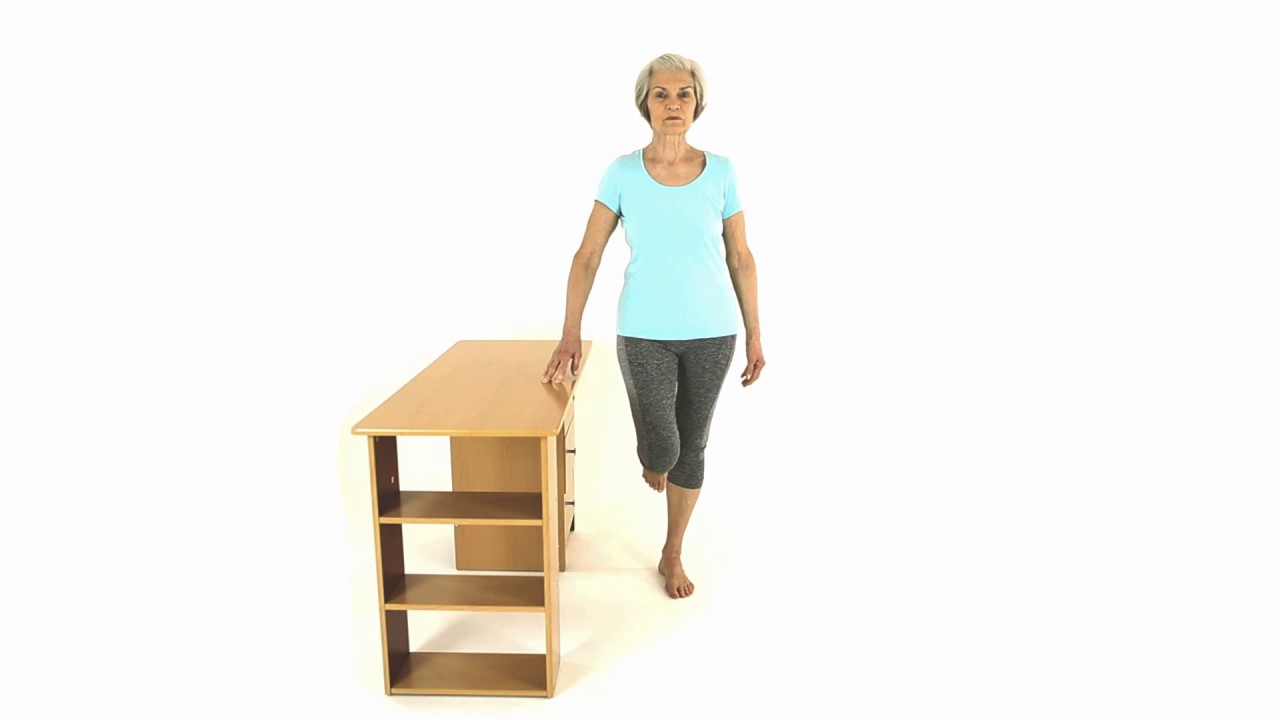
Hold the counter. Lift one foot a few inches off the floor. Hold 10 seconds, then switch. Build toward one fingertip on the counter, then no hands. Two sets per leg.
2. Heel-to-toe walk.
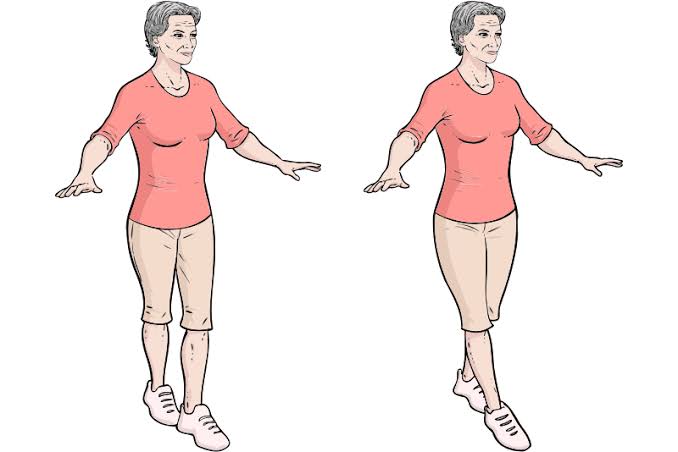
Place the heel of one foot directly in front of the toes of the other, so the feet touch. Walk 20 steps along a counter or hallway wall. This narrows the base of support, which is exactly the skill a narrow bathroom doorway demands.
3. Sit-to-stand without hands.
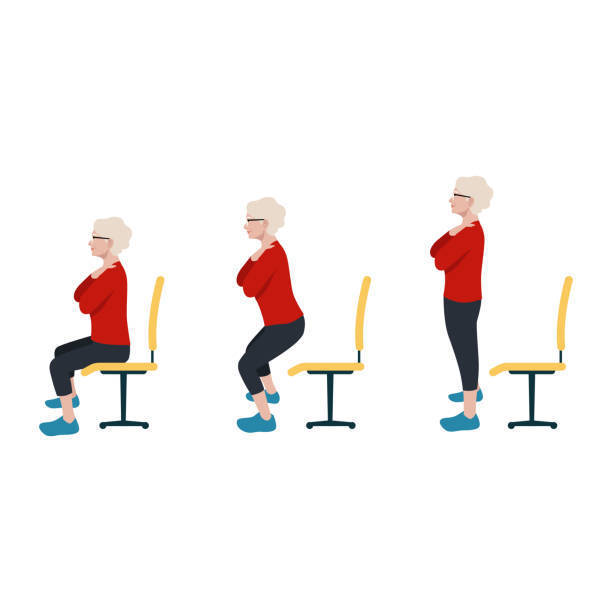
Sit in a firm chair, arms crossed over the chest, feet flat. Stand fully, then sit under control. Ten repetitions. This is the single most transferable move on the list, because rising from a chair, a bed, and a toilet is the same motion.
4. Heel raises.
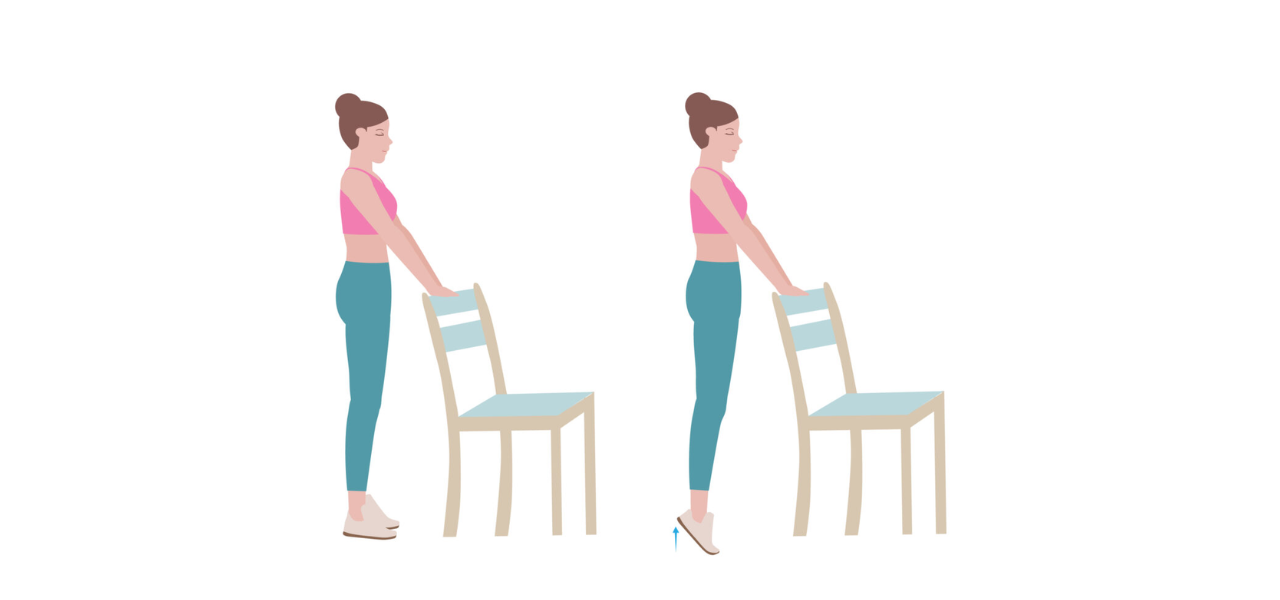
Hands on the counter. Rise onto the balls of the feet, hold two seconds, lower slowly. Fifteen repetitions. Calf and ankle strength is what stops a forward tip from becoming a fall.
5. Exaggerated stepping.
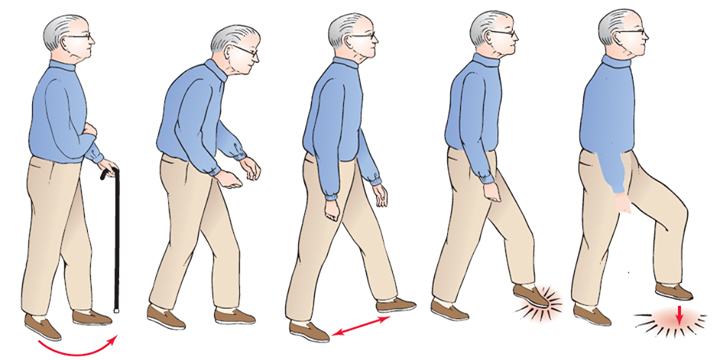
March in place, lifting each knee to hip height, holding one second at the top. Twenty steps. This trains the hip flexors that clear a threshold or a curb.
Ten to fifteen minutes covers all five. Progression matters more than volume: reduce hand support before adding repetitions. Residents at our community in Richmond's West End work these into ordinary parts of the day, standing at the sink or waiting for coffee, which is why they stick.
How Much Balance Training for Seniors Actually Works
Dose is where good intentions fall apart. Balance training for seniors needs frequency, and it needs to keep getting harder.
The World Health Organization recommends that older adults do multicomponent physical activity emphasizing functional balance and strength training at moderate or greater intensity, on three or more days a week, specifically to enhance functional capacity and prevent falls. That is the floor, not a stretch goal.
The strongest single trial on this is worth knowing by name. Fuzhong Li, a senior scientist at the Oregon Research Institute, tested a therapeutic tai chi program called Tai Ji Quan: Moving for Better Balance against a multimodal exercise program and against stretching. The trial enrolled 670 community-dwelling adults aged 70 and older who had already fallen or had impaired mobility. Sessions ran twice a week for 24 weeks. Published in JAMA Internal Medicine, the results showed 58% fewer falls than stretching and 31% fewer than the multimodal exercise program.
Two takeaways for a family. Twice a week for six months produced that result, so this is a habit, not a burst. And the program that won was the one built specifically around balance, not the one that mixed everything together. Balance exercises for seniors outperform general fitness routines because they train the exact system that fails.
Consistency also survives cognitive change better than most people expect. Balance routines rely on repetition and cueing rather than instruction, which is why structured movement stays part of the daily rhythm in memory care rather than dropping off it.
When Balance Problems in Elderly Parents Need a Physical Therapist
Some balance problems in elderly adults respond to a countertop routine. Some do not, and pushing through them wastes months.
Consider a pattern that comes up often. A daughter visits her father every Sunday. Over a few months she notices he takes the stairs one at a time now, both hands on the rail. He pushes off the armrests to stand. He has stopped walking to the mailbox. He mentions, once, that the room "swims" for a second when he gets up too fast. He has not fallen. He also has not told his doctor any of this.
That combination is a referral, not a home program. Dizziness on standing, a new need to use hands to rise, and a shrinking radius of movement point to causes a routine cannot fix on its own: blood pressure that drops on standing, medication interactions, inner ear changes, or a vision prescription that no longer matches.
Notice what the daughter has and does not have. She has a pattern observed over months, which is genuinely useful clinical information. She does not have a cause, and guessing at one delays the appointment that would find it.
Bring these to a physician:
- Any fall in the past 12 months, including ones nobody was hurt in
- Lightheadedness or a swimming sensation when standing up
- Needing both hands to rise from a chair
- New or worsening fear of falling
- Five or more daily medications, or any recent change to them
- Walking that has become slower, wider, or shuffling
Balance exercises for seniors remain useful in almost every one of these cases. They are simply no longer the whole plan. If cognitive changes are part of the pattern too, a physician will weigh that as well, and the level of support that involves is a separate conversation from steadiness on the stairs.
Clinicians have short, standardized tools for exactly this. The CDC's STEADI initiative uses the 30-second chair stand, the Timed Up and Go test, and the four-stage balance test to quantify what a family can only describe. A physical therapist then builds a program around the specific deficit, which is a different thing from a general exercise plan.
None of this replaces a doctor's evaluation. Describe the pattern you have observed, bring the medication list, and let the clinical team name the cause. Families who have moved a parent into our community often describe that conversation as the point where guessing stopped.
Steady Beats Sudden
Balance is trainable at 70, at 80, and at 90. The research is unusually consistent on that point. Balance exercises for seniors ask for something small and fairly boring: ten minutes, three days a week, one hand coming off the counter a little sooner than last month.
The payoff is not really about avoiding one bad afternoon. It is about the radius a person is willing to move in. Steadier legs mean the mailbox stays in range, then the garden, then the grocery store. Confidence follows capacity, in that order, not the reverse.
What it asks of family is different. It asks you to name what you have been noticing out loud, to someone qualified to interpret it, before a stumble does the naming for you.
Tell us what you have been watching for, and we will help you sort what belongs in a physician's evaluation from what a steadier weekly routine can handle on its own.
Frequently Asked Questions
What are the best balance exercises for seniors?
Single-leg stands, heel-to-toe walking, sit-to-stand without hands, heel raises, and high-knee marching cover the main balance skills. All five can be done holding a kitchen counter.
How often should seniors do balance exercises?
The World Health Organization recommends multicomponent activity emphasizing functional balance and strength on three or more days a week. Ten to fifteen minutes per session is enough to start.
How do you improve balance in seniors?
Train the specific skill by gradually reducing hand support during standing exercises, rather than only adding walking. Progression, not repetition count, is what drives improvement.
What causes balance problems in elderly adults?
Vision changes, inner ear changes, reduced sensation in the feet, leg muscle weakness, and taking five or more medications are the most common contributors. A physician can identify which apply.
Can balance exercises for seniors be done at home?
Yes. A sturdy counter or heavy chair, proper shoes, and a clear floor are the only requirements, though a second person should be present for the first few sessions.
When should a senior see a physical therapist for balance?
After any fall in the past year, or if standing causes dizziness, rising from a chair requires both hands, or walking has become slower or wider.
Sources:
- https://www.cochranelibrary.com/cdsr/doi/10.1002/14651858.CD012424.pub2/full
- https://www.cdc.gov/falls/data-research/index.html
- https://www.hopkinsmedicine.org/health/wellness-and-prevention/fall-prevention-exercises
- https://www.nia.nih.gov/health/exercise-and-physical-activity/three-types-exercise-can-improve-your-health-and-physical
- https://www.ncbi.nlm.nih.gov/books/NBK566046/
- https://pubmed.ncbi.nlm.nih.gov/30208396/
- https://www.cdc.gov/steadi/media/pdfs/STEADI-Assessment-30Sec-508.pdf
- https://www.cdc.gov/falls/data-research/facts-stats/index.html