The Melody Stays: What the Research Actually Shows About Music Therapy for Dementia
Eleanor hadn't said her daughter's name in months. Some days she didn't seem to recognize her at all. But when a caregiver played "You Are My Sunshine" one afternoon, Eleanor sang every word, correct key, correct tempo, without missing a beat. Her daughter stood in the hallway afterward, not quite crying, more caught off guard by the strange, specific relief of hearing her mother's actual voice again, clear and certain, for three minutes.
Moments like that aren't a fluke, and they aren't wishful thinking either. They point to something real happening in the brain, something that's become one of the more well-supported dementia-related discoveries of the last two decades: musical memory is often protected long after other kinds of memory have started slipping away.
Why the Song Survives When the Name Doesn't
The explanation isn't sentimental, it's neurological. A landmark 2015 study published in the journal Brain found that the brain regions most closely tied to musical memory, specifically the caudal anterior cingulate cortex and the ventral pre-supplementary motor area, are among the last areas affected by Alzheimer's disease, even as regions governing verbal and episodic memory deteriorate much earlier.
Musical memory also isn't stored in just one place; it draws on networks spread across the brain that handle rhythm, emotion, and movement simultaneously, which means Alzheimer's has to damage far more territory before a familiar song stops registering at all.
There's also a timing effect worth knowing about. Songs from someone's adolescence and early adulthood tend to be the most durable and emotionally powerful, a pattern researchers call the "reminiscence bump." Music encoded during that stretch of life was often tied to intense first experiences, first loves, milestones, formative years, which may be part of why it's encoded more strongly and retrieved more easily than music heard later on.
What a Real Music Therapy Session Actually Looks Like
This is where a lot of well-meaning families get the wrong picture. Music therapy isn't a speaker playing oldies in a common room. The American Music Therapy Association defines it as the clinical, evidence-based use of music interventions to meet specific, individualized goals, delivered by a board-certified music therapist who has assessed the person first.
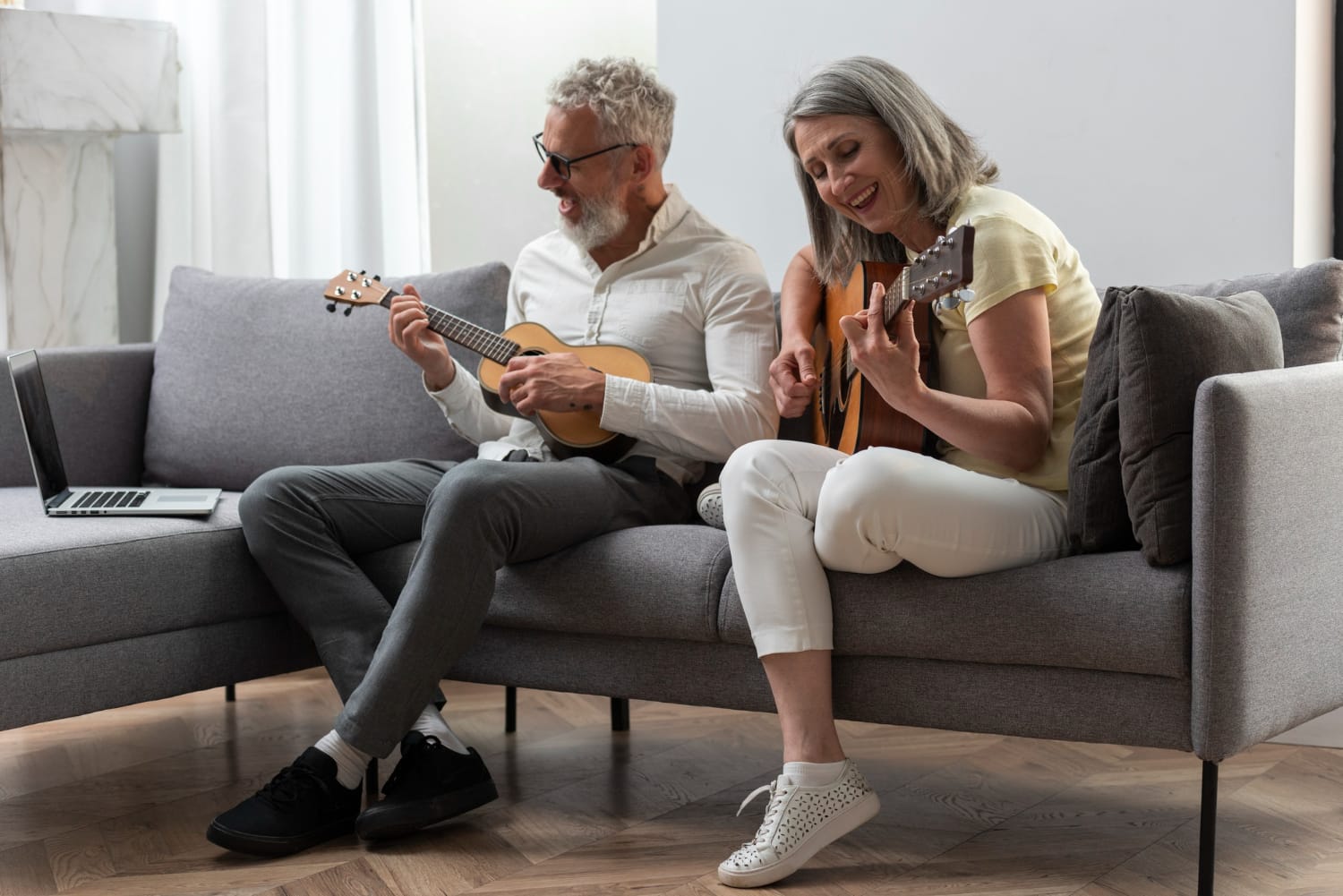
A real session might include live, interactive singing rather than passive listening, since active musical engagement tends to draw a stronger response than simply hearing music in the background. It might involve rhythmic movement to support motor coordination, an instrument placed in someone's hands to encourage participation, or a therapist deliberately choosing a specific song to work toward a specific outcome: easing anxiety before a caregiving task, opening a channel for communication, or supporting a quality-of-life goal identified during assessment.
It's structured and one-on-one far more often than people expect, not a group singalong, though group sessions have their place too.
What the Evidence Actually Supports
A 2018 Cochrane review, widely considered the gold standard for evaluating medical evidence, examined music-based interventions for dementia and found support for reduced depressive symptoms and improved overall behavioral outcomes, with more modest but still meaningful evidence for reduced agitation and anxiety.
A separate meta-analysis in Frontiers in Psychology reached a similar conclusion specifically on agitation. One consistent finding across this research is worth remembering when building a playlist at home: individualized, personally meaningful music outperforms generic "relaxing" or classical music for reducing agitation, which is exactly why a stranger's calming playlist rarely works as well as a spouse's or child's carefully chosen one.
When Music Tends to Help the Most
Music tends to be most useful around moments of distress rather than as constant background noise: agitation, anxiety before a transition like bathing or a doctor's visit, and the restlessness that often builds in the late afternoon and evening.
Many families find that introducing calm, familiar music proactively, before agitation peaks rather than after, works better than reaching for it only once things have already escalated. This timing matters for the same reasons discussed in our guide to dementia-related wandering, since both patterns often build gradually across the day rather than appearing without warning.
Building a Personalized Playlist That Actually Works
- Start with the reminiscence bump. Music from a person's teens through their late twenties is often the most powerfully retained.
- Prioritize songs with personal significance over generically "classic" songs from the same era, a wedding song matters more than a chart-topper from the same year that meant nothing personally.
- Include a mix of tempos. Upbeat songs for engagement and mood, slower ones for calming moments.
- Watch and adjust. A song that soothes one day may not land the same way the next; treat the playlist as a living tool, not a finished project.
- Pair music with other engagement. Structured, familiar activities built around music, like a sing-along or a simple rhythm activity, tend to hold attention longer than passive listening alone.
What Music Therapy Can't Do
It's worth being honest here: music therapy doesn't slow or reverse the underlying disease process, and it isn't a substitute for medical care or a cure for the condition driving the dementia itself. Its real value is in easing specific moments and symptoms, mood, agitation, connection, communication, not in changing the disease's trajectory.
Families should hold the same kind of realistic expectations here that they would with any other non-pharmacological approach to a serious condition: genuinely valuable, worth doing consistently, but not a substitute for the medical picture underneath it.
It's also worth noting that hearing loss, extremely common in this age group, can blunt music's effect if it's untreated, which is one more reason a hearing check is worth ruling out before assuming music simply "isn't working."
Music Is Already Part of How We Care for Residents
We don't treat music as an occasional activity here, we treat it as one of the more reliable ways to reach someone when words alone aren't getting through. At The Berkeley, our memory care team builds personalized music into daily routines, not just special events, because we've seen firsthand how often a familiar song opens a door that conversation alone can't.
If you're exploring memory care for a loved one and want to know how something as simple as the right playlist gets woven into real, everyday care, reach out to our team — we'd love to show you what that looks like here.
Frequently Asked Questions
Q: Do you need a professional music therapist to see any benefit, or can families do this at home?
A: Families can absolutely see real benefits from personalized music listening at home without a credentialed therapist, particularly for mood and agitation. A trained music therapist adds structured, goal-directed technique and works well for more complex behavioral or communication goals, but a thoughtfully built personal playlist is a legitimate, evidence-supported starting point on its own.
Q: Can music therapy help with dementia-related depression specifically?
A: Yes, this is actually one of the better-supported outcomes in the research, with reduced depressive symptoms showing up consistently across multiple systematic reviews, sometimes more reliably than the evidence for agitation specifically.
Q: Does the type of dementia affect how well music therapy works?
A: To some degree. Musical memory preservation has been most studied in Alzheimer's disease specifically, and response can vary by dementia type and stage, so it's reasonable to expect some trial and error regardless of diagnosis rather than assuming a uniform response.
Q: Is singing along more beneficial than just listening to music?
A: Many researchers and therapists believe active participation, singing, clapping, playing a simple instrument, engages more of the brain than passive listening alone, though passive listening still shows real benefits and is a reasonable starting point for someone who isn't up for more active participation.
Sources
- Jacobsen, J.H. et al., Why Musical Memory Can Be Preserved in Advanced Alzheimer's Disease, Brain (2015) — https://academic.oup.com/brain/article/138/8/2438/329009
- van der Steen, J.T. et al., Music-Based Therapeutic Interventions for People with Dementia, Cochrane Database of Systematic Reviews (2018) — https://www.cochranelibrary.com/cdsr/doi/10.1002/14651858.CD003477.pub4/full
- Pedersen, S.K.A. et al., Effects of Music on Agitation in Dementia: A Meta-Analysis, Frontiers in Psychology (2017) — https://www.frontiersin.org/journals/psychology/articles/10.3389/fpsyg.2017.00742/full
- American Music Therapy Association, Definition and Standards of Practice — https://www.musictherapy.org/about/musictherapy/