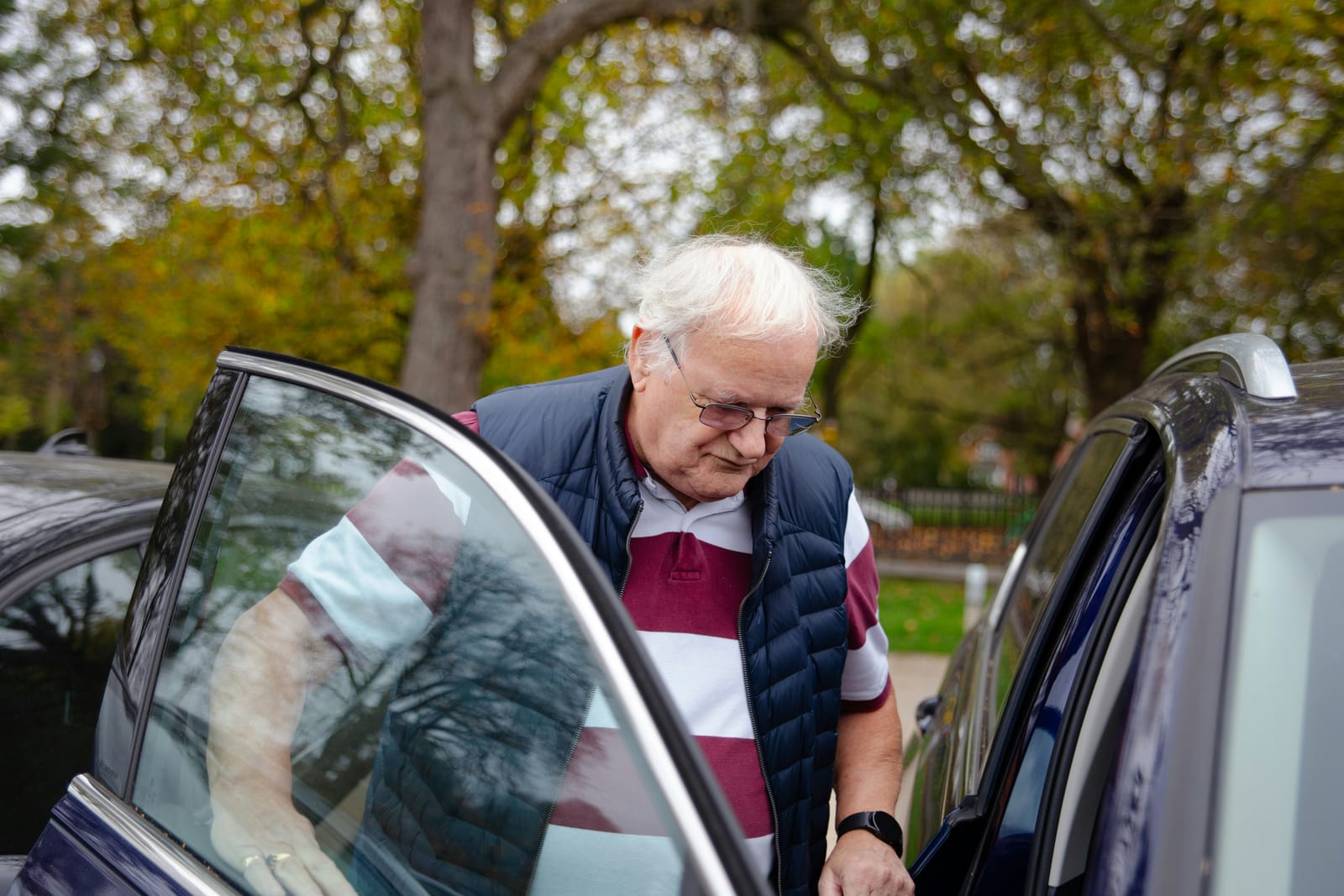

The keys sit on the hook by the door. Same hook, forty years.
Nobody in the family wants to be the one who moves them. So everyone waits, and quietly hopes the doctor says something first.
Here's what makes that wait risky: with driving and dementia, the person behind the wheel is usually the last one who will notice.
Quick answer: A dementia diagnosis does not automatically mean driving stops that day. Many people in the earliest stage still drive safely for a time. But driving and dementia have a fixed endpoint — nearly everyone with dementia will eventually need to stop, because the condition is progressive. The most reliable signals are dementia severity as measured clinically, and a caregiver's rating of the driving as marginal or unsafe. The least reliable signal, established by strong evidence, is the driver's own assessment of themselves. The right next step is usually a comprehensive driving evaluation by an occupational therapy driving rehabilitation specialist, not a family argument.
Driving and dementia: what the evidence actually establishes
The American Academy of Neurology published a practice parameter on driving risk in dementia based on a systematic review of the literature. It graded each possible warning indicator by evidence strength, which makes it unusually useful for families.
What predicts unsafe driving:
Indicator | Evidence level |
Clinical Dementia Rating (CDR) scale score | Level A (strongest) |
A caregiver rating the driving "marginal" or "unsafe" | Level B |
History of crashes or traffic citations | Level C |
Reduced mileage or avoiding certain driving situations | Level C |
Mini-Mental State Exam score of 24 or below | Level C |
Aggressive or impulsive personality traits | Level C |
What does not predict it: the patient's own self-rating of their driving ability, graded Level A. That is the strongest evidence grade in the whole document, and it points at the thing families most often accept as reassurance.
Three findings deserve unpacking.
Severity matters more than diagnosis. For drivers with a CDR of 1, point estimates of relative risk for failing an on-road test, compared with drivers without dementia, ranged from 2.68 to 88.76. That range is enormous, which is itself the point: risk varies hugely between individuals at the same stage.
Mild impairment is genuinely mixed. Among people with CDR scores of 0.5 to 1, studies found that 41% to 85% were safe drivers on formal on-road testing. So a diagnosis alone does not justify taking the keys, and it does not justify leaving them either.
Self-restriction is a warning sign, not a solution. Drivers who continue with self-imposed restrictions — no highways, no night driving, no rain — show a fivefold increase in crash risk. Families often read "he only drives to church now" as evidence that things are under control. The research reads it as a flag.
One more finding worth sitting with: among people with mild Alzheimer's who rated themselves as safe drivers, the on-road test pass rate was 41%. In one study, every single person with mild dementia who failed the road test had considered themselves safe.
As the AAN's lead guideline author put it, while some people with dementia can still drive safely for a time, nearly all will eventually have to give up driving — which is why the conversation belongs soon after diagnosis, not after an incident.
Driving and dementia warning signs families should watch for
The Alzheimer's Association lists specific behaviors that suggest it's time to stop driving. Paraphrased and grouped:
Navigation and orientation
- Getting lost on routes they've driven for years
- Forgetting mid-trip where they were headed
- Taking far longer than usual on a routine errand, with no explanation
Judgment and reaction
- Slow or poor decisions in traffic
- Driving too fast or unusually slowly for conditions
- Missing or ignoring traffic signs and signals
- Errors at intersections
Vehicle control
- Drifting out of the lane
- Hitting curbs
- Confusing the accelerator and brake
Emotional signals
- Becoming angry, agitated, or confused while driving
The National Institute on Aging adds physical evidence families can check without being in the car: new dents or scrapes, multiple near-misses, two or more tickets or minor accidents, or a rising insurance premium.
The Family Caregiver Alliance recommends something practical here: keep a written log of each incident, with dates. A log is harder to dismiss than a feeling, it helps a physician, and it gives you something concrete to point to in the conversation instead of "I've just been worried."
Driving and dementia: signs that mean stop today, not eventually
Some events don't need a log or a second opinion. Driving should stop immediately, pending professional assessment, after:
- Confusing the gas and brake pedals
- Getting lost on a familiar route
- Driving into oncoming traffic
- Striking an object, a curb, or another vehicle
- Repeatedly missing stop signs or red lights
These are treated as immediate stop events rather than warning signs, because the failure mode is catastrophic and the next occurrence is unpredictable.
If there are any real doubts about safety, the Family Caregiver Alliance's guidance is direct: the person should not be driving.
Get an evaluation, not a verdict from the family
This is the single most useful move available to families in a driving and dementia situation, and most never hear about it.
A comprehensive driving evaluation by an occupational therapy driving rehabilitation specialist assesses vision, reaction time, judgment, and decision-making, and includes a behind-the-wheel component. The Alzheimer's Association describes it as the proactive strategy rather than waiting for warning signs to accumulate.
What makes it valuable isn't just accuracy. It's that the answer comes from a neutral professional rather than from a daughter. That changes the conversation from a family betrayal into a medical finding.
Practical details:
- Look for a CDRS (Certified Driver Rehabilitation Specialist, credentialed by ADED) or an occupational therapist with driving specialty certification. Both ADED and AOTA maintain searchable provider databases.
- Cost: AAA puts a full assessment at $200 to $400 or more, with rehabilitation around $100 an hour. Research surveying driving rehabilitation programs found a median evaluation cost of $400, with 36% reporting no third-party reimbursement.
- Coverage: NHTSA notes that health insurance may cover part or all of an evaluation, and that a doctor's prescription may be required to access those benefits. Ask before you assume it's out of pocket.
Outcomes aren't binary. An evaluation can clear someone to keep driving, recommend restrictions or training, or find that it's no longer safe. That range is exactly why it beats a family vote.
How to have the driving and dementia conversation
There is no script that makes this painless. There are approaches that make it survivable.
Start before you have to. The Alzheimer's Association suggests that while someone is still in the early stage, you ask them to sign a driving contract giving a named person permission to help them stop when the time comes. Made early, that's a person deciding their own future. Made late, it's a confrontation.
Lead with specifics, not with the conclusion. "You need to stop driving" invites a defense. "Last Tuesday you came back from Kroger after ninety minutes and couldn't say where you'd been" is a fact. Your log does this work.
Separate the two conversations. Whether their driving is safe is a question for a professional. What they'd miss if they stopped is a question for them. Blending them turns an assessment into an argument.
Bring in the physician. The NIA notes that a doctor can write "do not drive" on a prescription pad, which you can then show the person. For many families, an instruction from a physician lands where a daughter's plea doesn't.
Pause when it heats up. If the discussion escalates, stop and return to the specific incidents later, when everyone is calmer. The exception is a live danger, which shouldn't wait for a better moment.
When they refuse anyway
Some people recognize the risk and stop on their own. Many do not, because insight is often one of the first things the condition takes. This is the part of driving and dementia that families find hardest: the refusal is a symptom, not stubbornness.
The NIA lists concrete options when talking hasn't worked: hide the keys, disable the car, move it out of sight, or sell it. Those feel harsh written down. They are also, at a certain point, the only remaining safeguards.
A gentler sequence many families use first: let the registration or insurance lapse, arrange for the car to be "in the shop," or park it at another relative's house. These work best alongside a real transportation plan, not instead of one.
Driving and dementia in Virginia: how the DMV process works
Virginia families have a formal route, and most don't know it exists.
Medical Review Services (MRS) is the DMV team that reviews cases where a Virginia driver may have a medical or visual condition affecting driving ability. Any resident of Virginia can be reported as having a qualifying medical condition requiring MRS review. Reports also reach the DMV through law enforcement crash reports and through a driver's own statements on a license application.
How to file. Reports go to DMV Medical Review Services in writing or on the Medical Review Request (MED-3) form. The DMV also now runs an online Medical Review Services portal for customers and healthcare providers to submit forms electronically.
What happens next. A trained evaluator reviews the documentation under policies set with the DMV's Medical Advisory Board. The DMV may require a medical statement from a physician, PA, or nurse practitioner; a vision statement; or an evaluation by a Driver Rehabilitation Specialist. The outcome can be full licensure, a restricted license, or suspension. Drivers who disagree have an appeal path.
Two things worth knowing before you file. First, this is a real process with real consequences, including a possible Order of Suspension. Second, it exists precisely so that families aren't the only line of defense. Ask the physician whether they'll initiate it, since a clinician-originated report often carries more weight and spares the family relationship.
Driving and dementia alternatives that preserve dignity
A plan that only subtracts is a plan people fight. Build the replacement before you remove the car.
- Test alternatives while they're still driving. Doing this early means the new option feels familiar rather than punitive.
- GRTC CARE paratransit serves the Richmond region. Eligibility is based on functional ability, not age or diagnosis, and it takes time to process — apply early.
- Standing rides beat on-demand rides. A fixed Tuesday pickup for the pharmacy is easier to accept than a negotiation each time.
- Rotate the drivers. When four people each take one errand a month, nobody becomes the warden.
- Keep the destinations, not just the trips. The goal isn't transportation. It's church, the barber, the grandkids' games. Replacing the trip without protecting the destination is how isolation starts.
- Name it as a transition, not a punishment. The Alzheimer's Association frames this as maintaining control over mobility, not surrendering it.
For families in memory care, transportation is often already bundled into the care plan, which removes the daily negotiation entirely.
Two families, two routes
Families handle driving and dementia in roughly two ways: they build the evidence, or they build the replacement. Both work.
The log that ended the argument. A son kept a dated list for six weeks: two curb strikes, one ninety-minute trip to a store eight minutes away, one missed stop sign he witnessed. His mother had insisted she was fine, which the evidence says means nothing either way. He brought the log to her neurologist, who ordered a driving evaluation. She failed the behind-the-wheel portion. She was angry for a month, then relieved, and the fight was with the result rather than with her son.
The plan that came first. A daughter spent two months setting up alternatives before raising the topic — a standing Wednesday ride with a neighbor, a CARE application already approved, groceries delivered. When she finally asked her father to stop, the question wasn't "how will I live?" It was "who's driving Wednesday?" He handed over the keys in March.
The question nobody asks on a tour
Families touring senior living ask about the dining room, the apartments, the activities calendar.
Ask us about Thursdays instead.
Specifically: how does a resident who no longer drives get to a cardiology appointment, a standing hair appointment, the pharmacy, a grandson's graduation? That answer tells you more about daily life here than any floor plan will.
For some families, driving and dementia turns out to be the whole problem. The keys were the last thread holding an independent life together, and once they're gone the week becomes a logistics puzzle someone has to solve every single day. Our assisted living and memory care neighborhoods on Gaskins Road include transportation to appointments in the monthly rate, which is less a feature than a removed argument.
And if your answer to driving and dementia is a ride program and a good neighbor and staying right where you are, that's a real answer. We'll help you think it through either way.
Ask us how residents get where they're going →
FAQs
Does a dementia diagnosis mean you have to stop driving immediately?
Not necessarily. Driving and dementia can coexist briefly in the earliest stage. Many people in the earliest stage drive safely for a period, and studies found 41% to 85% of those with very mild to mild impairment passed on-road testing. But the condition progresses, so nearly everyone will eventually stop. Plan for it at diagnosis.
Who decides when someone with dementia should stop driving?
Ideally a professional, not the family. Driving and dementia decisions hold up far better when a neutral evaluator makes them. A comprehensive driving evaluation by an occupational therapy driving rehabilitation specialist is the most accurate assessment. Physicians and, in Virginia, DMV Medical Review Services also play formal roles.
Is a person's own opinion of their driving worth anything here?
No. Strong evidence establishes that a patient's self-rating of safe driving ability is not useful for identifying risk. A caregiver's rating of marginal or unsafe is a meaningfully better predictor.
What does a driving evaluation cost?
AAA cites roughly $200 to $400 or more for a full assessment. One survey of driving rehabilitation programs found a median of $400, with about a third reporting no third-party reimbursement. Health insurance sometimes covers it, occasionally requiring a doctor's prescription.
How do I report an unsafe driver in Virginia?
Submit a report in writing or on the MED-3 form to DMV Medical Review Services, or use the DMV's online portal. Any Virginia resident can be reported for medical review.
What if they refuse to stop and keep driving?
This is the most common driving and dementia impasse. The NIA's options include asking the physician to write a "do not drive" instruction, hiding the keys, disabling or relocating the vehicle, or selling it. Pair any of these with a genuine transportation plan.
Sources
- https://pubmed.ncbi.nlm.nih.gov/20385882/
- https://neurologytoday.aan.com/doi/10.1097/01.NT.0000372243.39166.80
- https://www.medscape.com/viewarticle/722221
- https://www.mdedge.com/familymedicine/article/32595/geriatrics/evaluation-and-management-driving-risk-dementia
- https://www.aan.com/PressRoom/Home/PressRelease/819
- https://www.alz.org/help-support/caregiving/safety/dementia-driving
- https://www.nia.nih.gov/health/safety/driving-safety-and-alzheimers-disease
- https://www.caregiver.org/resource/dementia-driving/
- https://helpdementia.com/when-should-someone-with-dementia-stop-driving-warning-signs-and-conversation-tips/
- https://www.alz.org/help-support/caregiving/safety/dementia-driving
- https://www.aded.net/page/230
- https://www.aota.org/practice/clinical-topics/driving-community-mobility/driving-rehabilitation-program-development
- https://pmc.ncbi.nlm.nih.gov/articles/PMC4347878
- https://exchange.aaa.com/safety/senior-driver-safety-mobility/evaluate-your-driving-ability/
- https://www.dmv.virginia.gov/licenses-ids/license/medical/impaired-hp
- https://www.dmv.virginia.gov/licenses-ids/license/medical/review
- https://www.nhtsa.gov/node/4566
- https://virginianavigator.org/article/12857/driving-and-older-adult-virginia-dmv-process