
The Visitor Who Doesn't Need Words: What Pet Therapy Actually Does for Seniors
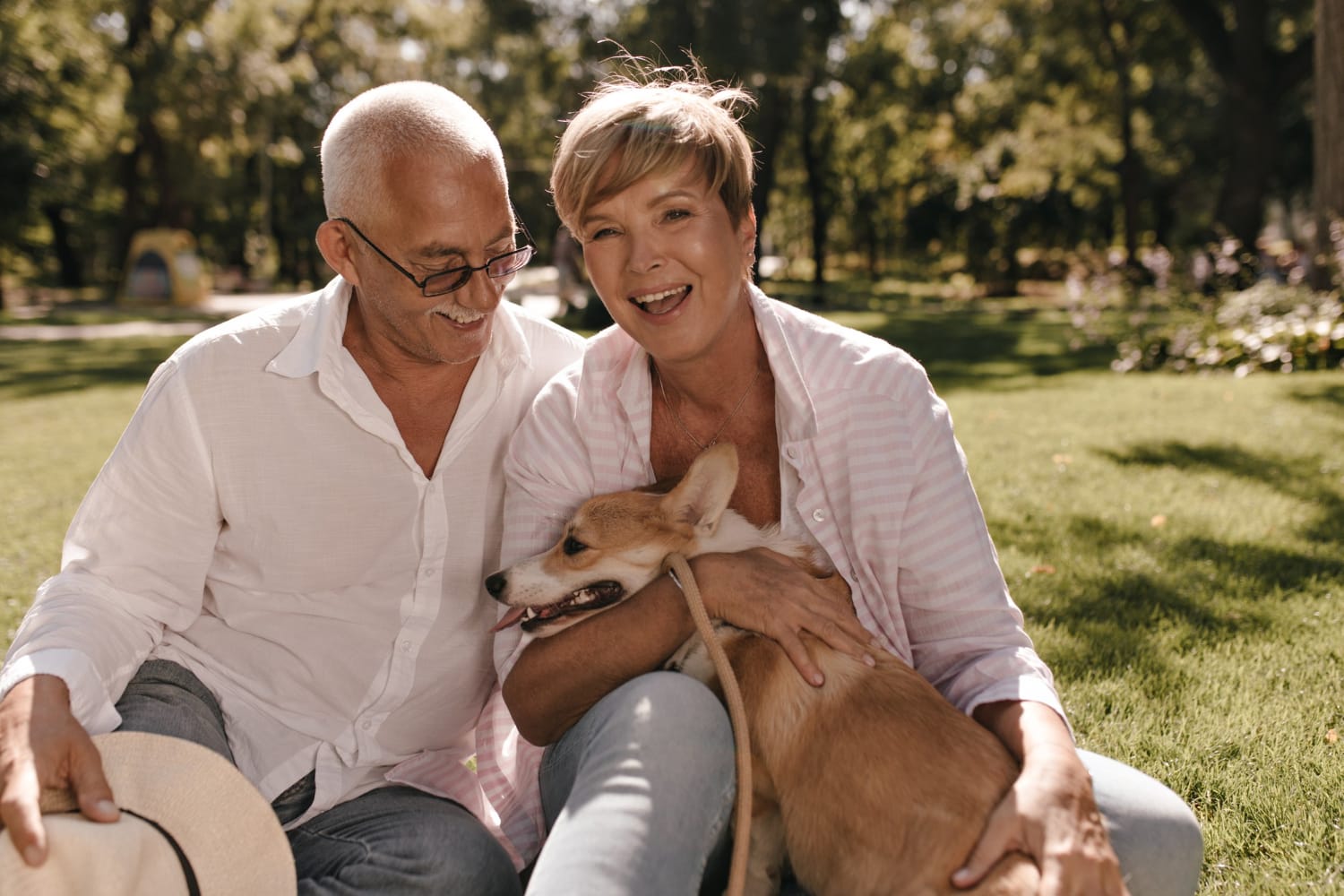
Marguerite hadn't said her granddaughter's name correctly in weeks. Conversations with her had become a guessing game, half-finished sentences trailing off into silence. But when a golden retriever named Biscuit padded into the activity room one Tuesday, she reached out before anyone could prompt her, scratched behind his ears, and laughed, the real, unguarded kind, for the first time that week.
Nobody taught Marguerite how to do that. She didn't need a working vocabulary, a clear memory, or even a particularly good day. The dog simply met her exactly where she was, and that turns out to be the whole point. The same kind of connection that makes social engagement protective for healthy aging doesn't disappear when words get harder. It just needs a different doorway in.
What the Research Actually Shows
Animal-assisted interaction has a genuinely solid research base behind it, not just a nice idea. Multiple reviews of studies on people with dementia found that interacting with animals reduces agitation and aggression, improves social interaction and communication with staff and family, and lifts mood and quality of life.
Physiologically, quiet interaction with an animal has been shown to lower blood pressure and heart rate and increase neurochemicals associated with relaxation and bonding, the same calming response you'd expect from any genuinely soothing, low-demand interaction.
It's worth being honest about the limits too. Researchers have noted that response can decrease somewhat as dementia becomes more advanced, and the benefit isn't identical for everyone. This isn't a universal fix, it's a genuinely effective tool that works especially well for a specific kind of connection: present-tense, sensory, and judgment-free.
Two Different Things Called "Pet Therapy"
Families often use "pet therapy" to mean two different arrangements, and it's worth knowing which one you're actually talking about.
Formal animal-assisted therapy programs involve a trained, registered animal and handler team visiting on a set schedule, working toward specific goals, more social interaction, calmer affect, a structured activity, as part of a broader care plan.
A resident having their own pet, where allowed, is a different and equally legitimate arrangement: daily companionship, routine, and a sense of responsibility that doesn't depend on a scheduled visit. Interestingly, researchers have found the relative benefits of a resident's own pet versus a visiting therapy animal aren't clearly settled one way or the other. Both are real. They're just not interchangeable, and a community that only offers one isn't necessarily missing something, it's offering a different kind of connection, closer to the steady presence described in our piece on companionship care for seniors.
What a Formal Pet Therapy Visit Actually Looks Like
A real therapy animal visit is more structured than it might look from the outside. Registered animal-handler teams go through a formal evaluation covering the animal's temperament, obedience, and health, and the handler's training in how to manage a safe, calming visit.
These programs cover far more than dogs, cats, rabbits, guinea pigs, horses, llamas, birds, rats, and miniature pigs are all used in various registered programs, so the image of a golden retriever in a hallway is only part of the picture.
Visits are supervised the entire time, scheduled in advance, and adaptable to what a resident can actually engage with that day. Importantly, actively petting the animal isn't required to benefit; some residents simply enjoy watching calmly from a chair, and that counts as real engagement too.
For residents who are steadier on their feet, a supervised visit sometimes includes a short, slow walk alongside a calm therapy dog, a gentle form of movement worth pairing with the kind of guidance in our balance exercises for seniors if fall risk is already a consideration.
How Families Can Find or Request a Program
If a community doesn't already have a regular visiting program, it's worth asking directly, many are glad to coordinate one through local registered teams or a national registry of certified animal-handler teams. Local shelters, 4-H programs, and therapy-dog organizations often maintain their own volunteer rosters as well.
Visits typically need a few weeks' lead time to schedule properly, so this is worth raising well before a specific occasion rather than the week of. It's also worth pairing a request like this with a look at a community's broader activity calendar; our guide to senior activities in Richmond covers other ways to build regular, engaging structure into a week.
When It's Not the Right Fit
Pet therapy is genuinely wonderful for many families, but it isn't universal, and honest guidance matters more than enthusiasm here. Allergies, a fear of animals, a compromised immune system, or certain medications can all make live-animal interaction risky or simply unpleasant rather than calming. None of this should be pushed past.
For families in exactly this position, robotic companion animals, most notably PARO, an FDA-cleared robotic seal designed specifically for dementia care, offer a genuine alternative rather than a consolation prize.
Research has found PARO can meaningfully reduce anxiety and increase verbal engagement in people with dementia, with none of the allergy, safety, or care-burden concerns of a living animal. It's a real option worth asking a community about, not just a novelty.
Especially Valuable for Residents with Dementia
Timing matters here as much as the interaction itself. Some research has specifically looked at animal visits scheduled during the late-afternoon "sundowning" window and found measurable increases in calm, social behavior during a stretch of the day that's often the hardest.
That's a similar logic to what we describe in our guide to wandering in dementia: restlessness often builds predictably across the day, and a calm, engaging presence introduced proactively tends to work better than anything introduced after agitation has already taken hold.
A Living Presence We Take Seriously, Not Just a Nice Photo Op
A visiting dog shouldn't be a once-a-year event captured for a newsletter photo. At The Berkeley, we treat animal visits as a genuine part of how residents, especially those in our memory care community, stay connected, calm, and engaged, alongside the same structure and intention we bring to spiritual wellbeing and the rest of daily life here.
If you'd like to know what our visiting schedule looks like, or want to talk through whether a resident's own pet could make sense for your family, reach out to our team — we're glad to walk you through it.
Frequently Asked Questions
Q: Is pet therapy covered by insurance or Medicare?
A: Generally no. Formal animal-assisted therapy sessions aren't typically billed as a covered medical service the way physical or occupational therapy are, so most programs are offered as part of a community's activity programming rather than through insurance.
Q: Do service dogs and therapy dogs do the same thing?
A: No, and the distinction matters legally. A service dog is individually trained to perform specific tasks for one person with a disability and has public access rights under the ADA. A therapy animal is registered to provide comfort to multiple people in settings like senior communities and has no such individual access rights outside that role.
Q: Can residents with mobility limitations still participate in pet therapy?
A: Yes. Visits are typically brought directly to a resident's chair, bed, or common area, and engagement can be as simple as gentle petting or just being near the animal, so limited mobility rarely rules someone out.
Q: How often do most communities offer pet therapy visits?
A: This varies widely, from weekly visits to occasional special events, depending on the community and local volunteer availability. It's reasonable to ask a specific community directly about their current schedule rather than assuming a standard frequency.
Sources
- Animal-Assisted Therapy in Elderly Patients: Evidence and Controversies in Dementia and Psychiatric Disorders, PubMed — https://pubmed.ncbi.nlm.nih.gov/29764282/
- Effectiveness of the Dog Therapy for Patients with Dementia: A Systematic Review, BMC Psychiatry — https://bmcpsychiatry.biomedcentral.com/articles/10.1186/s12888-019-2245-x
- Animal-Assisted Therapy for Dementia: A Review of the Literature, International Psychogeriatrics — https://www.intpsychogeriatrics.org/article/S1041-6102(24)04869-5/pdf
- The Utilization of Robotic Pets in Dementia Care, PMC — https://pmc.ncbi.nlm.nih.gov/articles/PMC5181659/