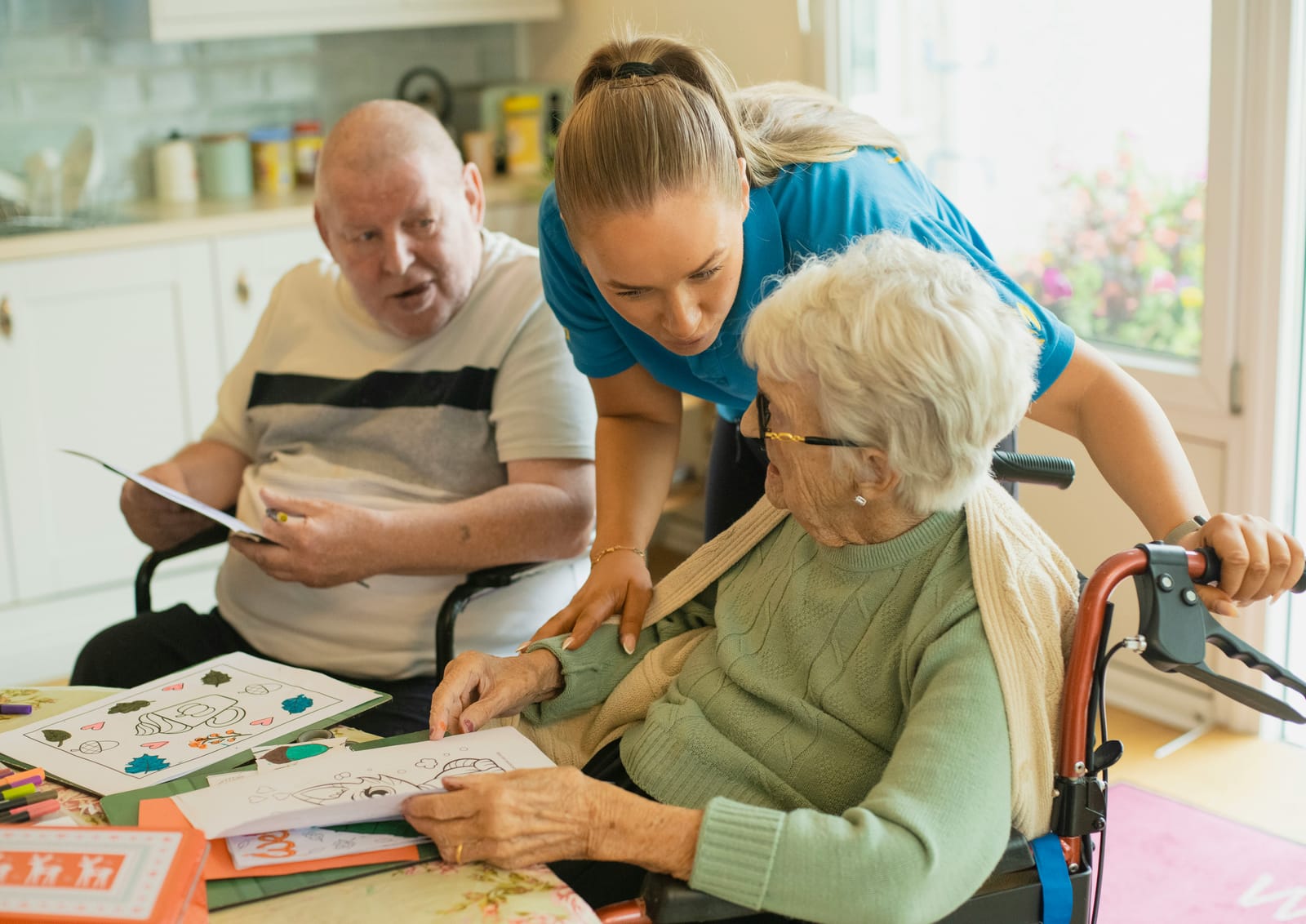


After decades of sharing a bed, a kitchen table, a life, one spouse moves into memory care and the other goes home to a house that suddenly feels enormous and quiet. This isn't a divorce, and it isn't a death, though it can feel like a strange, disorienting mix of both. It's a specific, real situation that deserves its own honest conversation, not just general advice written for adult children navigating a parent's care.
When one spouse moves to memory care, the marriage doesn't end, it changes form. This transition often brings a specific kind of grief for someone who is still alive, real guilt on top of decision fatigue built up over months or years, and a genuine need to protect the wellbeing of the spouse who remains at home. Staying connected across two different living situations is possible, and redefining what the relationship looks like now is part of that, not a betrayal of what it used to be.
A Loss With No Name Most People Recognize
There's a real, well-established term for what this specific grief actually is: ambiguous loss, a concept developed by researcher Pauline Boss to describe grieving someone who is physically present but psychologically changed or absent. It's different from the grief of a death, which at least has a clear beginning and a recognized process around it. This grief has no such clarity. According to the Family Caregiver Alliance, drawing on Boss's research, this kind of loss is uniquely stressful precisely because it lacks the closure other losses eventually offer.
Research specifically on spousal caregivers has used another term worth knowing: "married widowhood," describing the experience of a spouse, often a wife, caring for a husband with dementia while the marriage itself continues in an entirely changed form. Having language for this doesn't make it easier, but it does make it less isolating to know this experience has been studied, named, and recognized by people who understand it deeply.
Why This Decision Often Comes With More Guilt Than Any Other
If somewhere along the way you made a promise, spoken or simply understood, about never doing this, that guilt deserves real, direct attention rather than being pushed aside. For a spouse specifically, this decision often lands differently than it does for an adult child. It can feel like breaking a vow rather than making a caregiving choice, even when the decision was clearly, objectively the right one for both people involved.
This guilt is also rarely about one single decision. It's usually the accumulated weight of hundreds of smaller decisions made over months or years, when to ask for help, when to worry, when to finally admit something had changed permanently, each one exhausting in its own right, arriving at this point already depleted rather than fresh.
How This Decision Usually Gets Made
Recognizing signs it's time for help is often harder for a spouse than for an adult child watching from slightly more distance, since a spouse has usually been quietly compensating and adjusting for a long time before anyone else notices how much has actually changed.
Many couples explore in-home care as an alternative first, and for some, it genuinely extends the time a couple can stay together at home. For others, safety needs eventually outpace what in-home support alone can provide, and that's not a failure of the earlier effort.
Adult children are often part of this conversation too, and bringing them in directly rather than making the decision entirely alone can ease some of the weight, even though the decision itself still ultimately belongs to the spouse in a way it doesn't for anyone else involved.
What the Move Itself Actually Involves
The practical side of this transition, like helping any parent move, involves real logistics, but it carries its own emotional weight when the person doing the moving is also the one who will be going home to an empty house afterward.
Choosing the right community matters enormously here too, since this isn't a one-time visit but a place the at-home spouse will likely be spending real time in, regularly, for years. Community size and culture genuinely affects how comfortable and welcome a visiting spouse feels showing up often, not just occasionally.
Redefining the Relationship, Not Ending It
The marriage continues, even though its shape has changed completely. Connection is still possible, sometimes through conversation, sometimes through simply being present together, holding hands, listening to familiar music, sharing a meal on a visit, even as verbal connection becomes harder.
Some more recent work building on Boss's original framework describes this as maintaining a "we," continuing to do things together, in whatever form is actually possible now, rather than measuring the relationship only against what it used to be.
This reframing matters. The relationship isn't diminished by looking different than it did. It's continuing, adapted to a genuinely difficult new reality neither person chose.
Protecting the At-Home Spouse's Own Wellbeing
This part gets overlooked constantly, and it shouldn't. The spouse who remains at home has just lost their primary daily companion, often after decades of shared routine, and is at real risk of isolation precisely when support matters most. Genuine social connection isn't a luxury during this transition, it's a real protective factor for the at-home spouse's own health and mood.
Maintaining friendships, routines, and activities that exist independently of the marriage, not just visits to the memory care community, matters as much for the person staying home as it does for anyone navigating a major loss.
We Understand Both Sides of This
This transition touches two people at once, and both deserve real support, not just the one moving into memory care. The Berkeley at Short Pump welcomes spouses as an active, ongoing part of daily life here, not occasional visitors, and we understand that supporting a couple through this means supporting both of you.
If you're navigating this right now, get in touch and let's talk honestly about what comes next, and if memory care is part of that conversation, we're glad to walk through it with you directly.
Frequently Asked Questions
Is it normal to feel relief after a spouse moves to memory care?
Yes, and it doesn't cancel out love or grief. Relief often reflects the end of an unsustainable caregiving burden, not a lack of care for your spouse, and both feelings can be true for the same person at the same time.
Should the at-home spouse visit every day?
There's no requirement or universal right answer. What matters more is a sustainable rhythm that genuinely works for both people, since burning out from daily visits can ultimately reduce the quality of connection more than a slightly less frequent, more present visiting pattern would.
How do finances typically work when only one spouse needs memory care?
Specific protections exist under Medicaid rules to prevent a spouse remaining at home from being financially impoverished by a partner's care costs, though the exact rules are detailed and worth reviewing with an elder law attorney or benefits specialist directly.
Is it common for the at-home spouse to also need support eventually?
Yes, this is a well-recognized pattern. The stress of this transition, combined with the loss of a daily partner, can affect an at-home spouse's own health over time, which is part of why their own care and support matters just as much.
What if the at-home spouse wants to move to the same community?
Many communities can accommodate this, sometimes through a different level of care within the same campus. It's worth asking directly and early, since some couples find real comfort in being close by, even while living in different settings.
Sources:
- Family Caregiver Alliance, "Caregiving and Ambiguous Loss" (based on the work of Pauline Boss, PhD): https://www.caregiver.org/resource/caregiving-and-ambiguous-loss/
- "Ambiguous grief in wives caring for spouses with dementia," Redalyc: https://www.redalyc.org/journal/719/71982942006/html/