
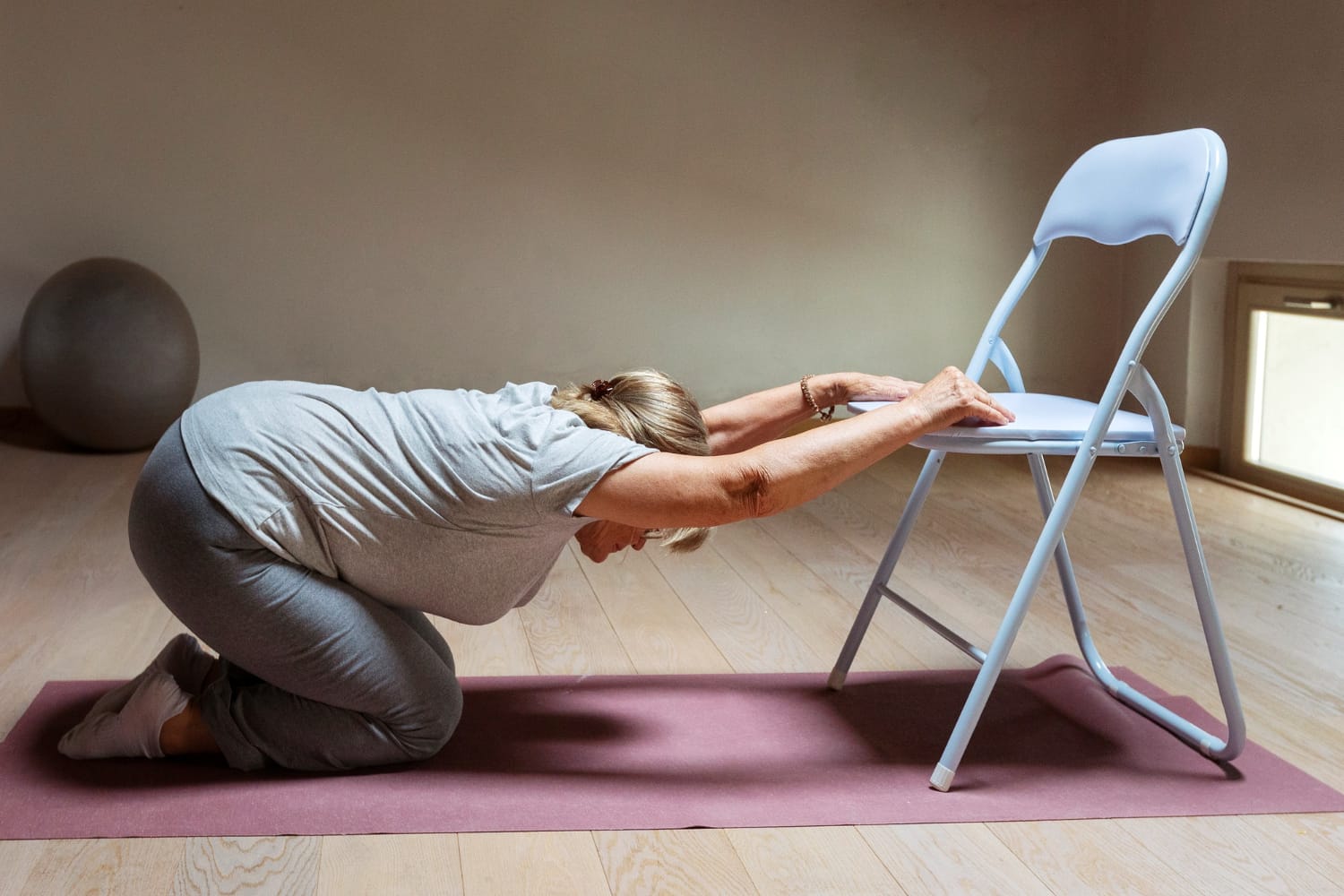

Traditional yoga can feel completely out of reach for someone managing joint pain, balance concerns, or limited flexibility, all that floor work and standing balance poses looking less like wellness and more like a fall risk. Chair yoga solves that problem directly, offering the real benefits of yoga practice without asking a body to do things it genuinely can't do safely anymore.
Chair yoga is a gentle adaptation of traditional yoga practiced while seated or using a chair for support. It's particularly well suited to older adults managing joint pain, limited flexibility, or balance concerns, and a real, growing body of research links it to improved mobility, reduced fear of falling, less joint pain, and better mood. Getting started is genuinely low-barrier: no mat, no floor work, and classes are widely available for older adults specifically.
What Chair Yoga Actually Is
Chair yoga is rooted in Hatha yoga and keeps the core elements of traditional practice, physical postures, breathing techniques, and a meditative focus, while adapting the poses to be performed seated or with a chair providing support and stability.
It isn't a watered-down version of "real" yoga. It's a legitimate, distinct practice designed specifically to make these benefits accessible to people for whom a traditional mat class would be unsafe or simply impossible.
Who It's Genuinely Good For
Chair yoga is particularly well suited to older adults managing joint pain and inflammation, limited flexibility, or real balance concerns that make a traditional class feel unsafe.
Research programs have even successfully adapted chair yoga for frail residents in assisted living and for people living with dementia, suggesting it can be modified for a wide range of physical and cognitive starting points, a pattern reflected in a recent case series examining chair yoga's feasibility for older adults with multiple health conditions.
If balance is a specific concern for your parent, chair yoga is worth considering alongside dedicated balance work, since the two address overlapping but distinct goals. It's also sometimes incorporated into recovery programs following a major medical event; if your family is navigating stroke recovery, it's worth asking a physical or occupational therapist whether chair yoga could reasonably fit into that broader rehabilitation plan.
What the Research Actually Shows
The research base here is genuinely encouraging, if still growing. A study of older adults with a median age of 88 found that eight weeks of regular chair yoga improved mobility and decreased fear of falling, with no adverse effects, along with improvements in balance, agility, gait, and limb flexibility.
Separate research on older adults with osteoarthritis found that an eight-week chair yoga program reduced joint pain, with that improvement still holding three months after the program ended, and a more recent study of older women with knee osteoarthritis found improved functional fitness after regular practice.
It's worth being honest about the state of the evidence rather than overselling it: results aren't perfectly consistent across every study, some research has found improvements in balance and flexibility without matching gains in other measures like walking speed, and many studies involve small sample sizes. The overall pattern across the research is genuinely positive, but chair yoga is best understood as one solid, low-risk tool among several, not a guaranteed fix on its own.
The Mental and Emotional Benefits Too
Beyond the physical findings, research has also linked chair yoga to reduced anxiety and depression, improved overall quality of life, and a calming effect tied to the breathing and meditative components built into the practice. For many older adults, the consistency of a regular practice, something to look forward to, a small sense of accomplishment, matters just as much as any single physical measure.
How to Get Started Safely
A typical chair yoga class involves gentle warm-up movements, a series of seated or chair-supported poses, and a slower cool-down, often incorporating breathing exercises throughout. Before starting, it's worth mentioning any specific physical limitations to an instructor directly, so poses can be modified appropriately from the start rather than adjusted reactively.
Starting at home is possible too, using a sturdy, armless chair on a non-slip surface, moving slowly, and stopping short of any real pain, though a supervised class is generally the safer starting point for anyone with significant balance or mobility concerns.
Finding a Class Near Short Pump
Chair yoga classes are increasingly common at senior centers, community centers, and wellness programs throughout the Richmond area. Our guide to senior activities around Richmond is a good starting point for finding local options, and many communities also offer chair yoga as part of structured adult day programs, worth asking about directly if that kind of daytime structure is already part of your family's plan.
How This Fits Into a Broader Wellness Picture
The setting where an activity like this happens matters more than people expect. Smaller, boutique-style communities often offer more personalized, closely supervised group fitness sessions than a larger setting can, which matters especially for something like chair yoga where individual modification really is the point.
Let's Talk About What Genuine Wellness Looks Like Here
Real wellness for your parent means having access to things like this, genuinely enjoyable, evidence-supported ways to stay active and engaged, not just custodial care. The Berkeley at Short Pump builds this kind of programming into daily life, not as an occasional extra. If you'd like to see what wellness and activity actually look like here, get in touch and we're glad to show you around, or talk through what assisted living could offer your family.
Frequently Asked Questions
Do I need any special equipment for chair yoga?
Just a sturdy, armless chair placed on a non-slip surface. No mat, special clothing, or additional equipment is required to get started.
How often should someone practice chair yoga to see real benefits?
Most research studies showing meaningful improvement involved regular practice over eight weeks or more, often a few sessions per week, suggesting consistency matters more than any single session.
Is chair yoga safe for someone with osteoporosis?
Generally yes, since chair yoga avoids the higher-impact and deep-bending movements that can be risky with reduced bone density, though it's worth mentioning an osteoporosis diagnosis to an instructor so specific poses can be modified appropriately.
What's the difference between chair yoga and regular stretching?
Chair yoga incorporates the breathing techniques and meditative focus central to traditional yoga alongside the physical postures, offering a more integrated mind-body practice than stretching alone typically provides.
Can someone in a wheelchair do chair yoga?
Yes, in most cases. Many chair yoga poses can be further adapted for a wheelchair, and instructors experienced with older or physically limited populations can typically modify a full session accordingly.
Sources:
- "Physical and Mental Benefits of Chair Yoga for Older Adults: A Case Series," PMC: https://www.ncbi.nlm.nih.gov/pmc/articles/PMC12591597/
- "Chair yoga for seniors: Benefits and poses for beginners," Medical News Today: https://www.medicalnewstoday.com/articles/chair-yoga-for-seniors